I don’t want to read your status updates anymore. It’s not because I don’t think you’re brilliant. It’s because I do.
I want to hear what you have to say. Not what 20 of your most distant acquaintances think about it. I want to hear you.
I don’t want you to feel limited by 140 characters.
Try 140 words instead. It’s brief enough that I can’t ignore you. It’s long enough that you can tell me a story I’ll remember.
I don’t want you to feel forced into taking on a casual voice when you want to express thoughts that aren’t casual.
When you have something to say that comes up from inside your bones, I want it to strike me me like a stand-alone expression of your soul. (When you type it out onto social media the world considers it crass over-sharing. I hate to admit that I do too.)
So please: when you have something meaningful to say, I want you to get off of Facebook and say it. Create your own web page. (Or better yet, a physical work of art.) Pick up a phone and remember what it’s like to live without barriers. (Or at least, less glaring ones.)
How can you you use social media instead? Use it to tell me what you had for breakfast.
I know that for years people have told you not to. But forget that. You’re allowed. (Anyone who doesn’t wonder how Einstein took his eggs lacks imagination.)
But please: don’t use social media to tell me something meaningful. (It will be cheap, and you won’t own what you say. Literally and legally.)
Instead, use social media to link me in to something meaningful.
The next time you have something brilliant to say on social media, stop.
Save it. Turn it into art. Then, you can use social media to tell me about it.
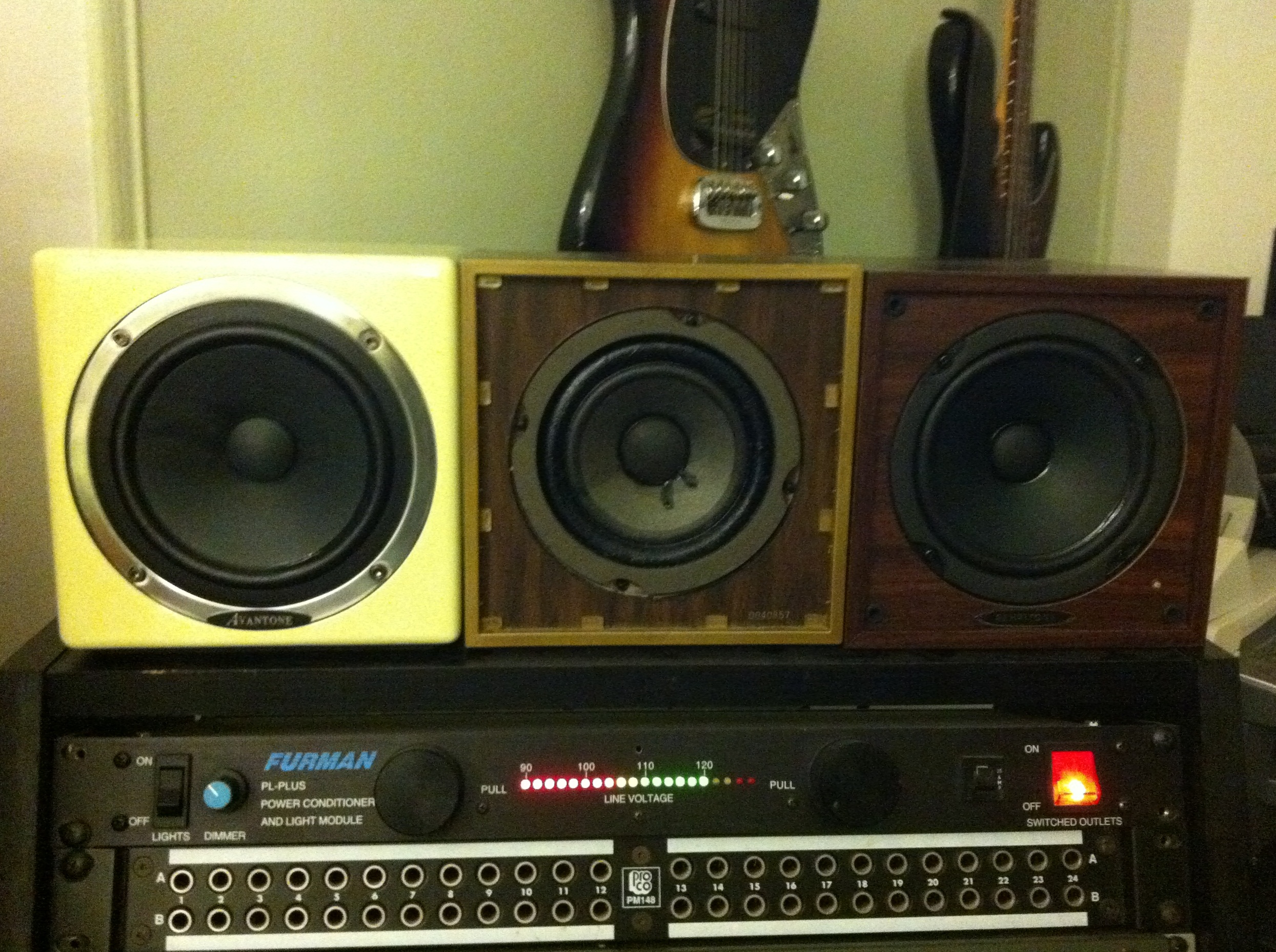
In the story I mentioned one of my favorite speaker designs of all time: The Auratone 5C Super Sound Cube. These little boxes, made by the Bose in the 1970s, are some of my favorite studio tools, period.
The Auratones’ strength lies in their ability to bring the midrange — the very heart and soul of each record — into focus.
These pint-sized and eternally useful studio monitors have been getting more and more expensive on the vintage market over the years, so now, two new companies have stepped in to offer their own versions of this simple, classic design.
A lot of people have been asking about these unofficial reissues from Avantone and Behringer, but I’ve yet to hear of anyone who’s gotten all 3 versions together in one room for a true roundup.
Luckily, I have an original Auratone pair that travels with me wherever I mix, and both Avantone and Behringer were kind enough to send me their own new versions of the speaker for my official Trust Me, I’m A Scientist review. Look for it in the new issue, out the first Monday of February.
Left to Right: Avantone MixCube, Original Auratone 5C Super Sound Cube, Behringer ("Behritone") C5a Powered Monitor
It’s fascinating to see how the art and economics of a label can work on their scale. They release about 8 records each year – essentially 2 per season. Based on their budgets, as long as a record sells 5,000 copies, they can consider it a success.
Many of their releases of course sell much, much more, but it means that unlike a major, they have to be deeply invested in every single album they put out.
Through all their successes, Frenchkiss has stayed firmly independent, and now they’re launching their very own label group. (Think Beggars Group/Matador/4AD)
This profile is the first in a series that will run over the next year. I’ve got profiles in the works for about a half-dozen prominent NYC indie labels, and if you have opinions on who else we should reach out to, feel free to let me know.
I don’t know marketing guru Seth Godin very well, although I do know his work. We’ve never met in person, and I’m sure he’d only vaguely remember my name, if at all. But from time to time I write to him, and he writes back.
Sure, they’re brief 1-3 sentence notes, but they’re thoughtful, even if they’re a little distanced. I figure that only makes sense. You see, like another of my publishing heroes, Tape Op editor Larry Crane, Seth actually reads all of his emails. And if his replies to me are any indicator, he seems to respond to a lot of them.
I like Seth. I like that he’s a busy, well-known author who manages to get through all of his random personal correspondence. I like his simple, direct writing style, and I think history has proven a lot of his observations about the music industry to be true. I agree with him strongly and often. (At least much more often than I’ve disagreed with him on things like his laissez-faire attitude toward protecting artists’ rights on the web.)
But today, I read an article that made me think again about one of those personalized emails I value so much. This week, New York Times Op Ed columnist Thomas L. Friedman writes that “Average Is Over“:
In the past, workers with average skills, doing an average job, could earn an average lifestyle. But, today, average is officially over. Being average just won’t earn you what it used to. It can’t when so many more employers have so much more access to so much more above average cheap foreign labor, cheap robotics, cheap software, cheap automation and cheap genius. Therefore, everyone needs to find their extra — their unique value contribution that makes them stand out in whatever is their field of employment.
It’s a refrain I’ve heard a lot from Seth over the years as well. He’s even written a book about it. Godin’s bestseller Linchpin is about becoming exceptional, because let’s face it: average isn’t cutting it any more.
Don’t get me wrong. It’s not that I disagree that working hard to become the best in your niche is a bad idea. Actually, it’s fantastic, if not somewhat obvious, advice. And it’s not that I disagree that “average” Americans are in fact, no longer guaranteed an “average” lifestyle for working hard at average jobs. The state of wealth disparity and debt distribution today proves that point pretty well by itself. What I disagree about is whether we should, or could, do something about it.
If Seth Godin and Tom Friedman are looking for exceptional, they only have to look as far as the comments section on Friedman’s article. The Times employs a commenting system that allows users to “recommend” the best posts by other commenters. On average, one of the better comments might expect to get 10 recommendations from fellow readers. The following comment, from a poster with the handle “Angry American,” got 400 — 40 times that amount:
No kidding, Tom. You’ve been saying this for quite a while. The problem is that half the population has a “below-average” IQ. What can they possibly do to become “above average?” Smile a little harder (through whatever untreated physical or emotional pain they are experiencing) as they clean a .01-percenter’s toilet? Or, sing a little tune as they change an elderly 1-percenter’s sleeping diapers? Or, work 3 minimum wage jobs just to pay for their spouse’s dental work? Wait, are we sure we want them to smile? it might reveal their rotted teeth (from a lifetime without good nutrition or dental care)… COME ON, TOM. Not everyone is an artisan, an “Iron Chef,” or a Mother Teresa.
REAL PEOPLE ARE HURTING. We’ve shredded their safety net while simultaneously vaporizing the jobs that “average people” used to do.
Tom, of the other half of the population who are “above-average,” only about 5% have seen any increase in income growth over the past couple of decades. Why? Well, being above-average isn’t enough in our increasingly winner-take-all society. It’s not. With RARE exceptions, our society is only working out for those who are lucky enough to be born physically and emotionally healthy to married, healthy, telegenic, college-educated parents (preferably with advanced degrees), who earn more than $300,000 (enough for the children to afford a vibrant, safe neighborhood, and an elite education K through grad/med/law school education). Wake-up, Tom.
That is – even if we’re able to make certain that all Americans have equal opportunities to show their best work and compete to get ahead (which happens to be yet another placewe’re failing), there’s a dark side to adopting a complete meritocracy, even if its a fair one. To make the point, Karabel quotes Michael Young, the British sociologist who coined the very term “meritocracy” itself.
In Young’s view, equality of opportunity — the sacred principle of American meritocrats — meant the “equality of opportunity to be unequal.” Under the meritocracy, individual mobility for the talented children of the working class was a real possibility. “But for the working class as a whole the victory was a defeat.” Perhaps worst of all, from Young’s perspective, was the effect that meritocratic competition had on winners and losers alike.
In the meritocracy, Young writes, “the upper classes are … no longer weakened by self-doubt and self-criticism,” for “the eminent know that success is just a reward for their own capacity, for their own efforts, and for their undeniable achievement … As for the lower classes,” they “know that they have had every chance” and have little choice but to recognize that their inferior status is due not as in the past to a denial of opportunity, but to their own deficiencies.
Though a meritocracy initially favors social mobility, Young observes that over time it produces “an elite [that] is on its way to becoming hereditary.” … This is what seems to have happened at the Big Three, where the children of the culturally capitaled enjoy a massive advantage in the competition for admission and the children of families not so endowed find themselves effectively excluded from the race before it begins.
…[T]he struggle for a more meritocratic university system — and for a more meritocratic society — is still worth waging. But Americans, whether at the Big Three and similar universities or well removed from them, would do well to heed Young’s final warning: we neglect the dark side of meritocracy at our collective peril.
Karabel raises a good point. In another portion of the book, he asks outright what good equality of opportunity is without equality of condition. I posed the same question to Seth. His hope was that if we could figure out equality of opportunity, and really get it right, we might be able to worry less about equality of condition.
Seth’s a self-described optimist, and he’s certainly entitled to his opinion, but I’m not so sure. I wonder if he ever read the book I recommended to him — Kurt Vonnegut’s Bluebeard. It probably has more true things to say about art than any other novel I’ve read. In it, Vonnegut’s Narrator (an aging Abstract Expressionist painter) writes:
I was obviously born to draw better than most people, just as the widow Berman and Paul Slazinger were obviously born to tell stories better than most people can. Other people are obviously born to sing or dance or explain the stars in the sky or do magic tricks or be great leaders or athletes, and so on.
I think that could go back to the time when people had to live in small groups of relatives — maybe fifty or a hundred people at the most. And evolution or God or whatever arranged things genetically, to keep the little families going, to cheer them up, so that they could all have someone to tell stories around the campfire at night, and somebody else to paint pictures on the walls of caves, and somebody else who wasn’t afraid of anything, and so on.
That’s what I think. And of course a scheme like that doesn’t make sense anymore, because simply moderate giftedness has been made worthless by the printing press and radio and television and satellites and all that. A moderately gifted person who would have been a community treasure a thousand years ago has to give up, has to go into some other line of work, since modern communications put him in daily competition with nothing but the world’s champions.
The entire world can get along nicely now with maybe a dozen performers in each area of human giftedness. A moderately gifted person has to keep his or her gifts all bottled up until, in a manner of speaking, he or she gets drunk at a wedding and tap-dances on the coffe table like Fred Astaire or Ginger Rogers. We have a name for him or her. We call him or her an “exhibitionist.”
How do we reward such an exhibitionist? We say to him or her the next morning. “Wow! Were you ever so drunk last night!”
Maybe sometime, I’ll ask him.
(PS – Seth and Larry are the two biggest reasons I keep a clean inbox today. If they can do it,I figure that so can the rest of us. If you write to me I will read it. And as long as you’re not being insane, I’ll respond.)
This morning, Chad Clark of Beauty Pill, the excellent Dischord Records post-rock band, tweeted:
“[W]ondering about budgets behind entirely electronic records in 2012. The economic framework has to be different than rock music.”
and
“If Tape Op hasn’t done a piece on this topic, they should. Or maybe a cool topic for @TrustMeScience? Get on it, Justin! CHOP CHOP!”
Chad knows that I’m borderline obsessed with the intersection of arts and economics.
Now, in addition to having a good excuse to mention Beauty Pill’s recording-studio-as-art-installation-project, Immersive Ideal, I also have a good reason to say that this week, I began conducting interviews with some NYC most significant true indie labels. And it’s questions like these that I love most.
There’s a lot of confusion these days about what is and is not an indie label. Too often, labels that seem indie are, in reality, boutique imprints owned by major conglomerates.
Dischord Records, which is owned by Ian MacKaye of Fugazi and Minor Threat, is not one of those fake indies. Neither is the first subject of my new series on labels for SonicScoop: NYC’s Frenchkiss Records.
As far as production costs for this (mostly rock) label are concerned, label head and Les Savy Fav bassist Syd Butler told me last night:
“We basically give the bands some money, and tell them they can use it to go make a record… or not.”
“Sure, we expect them to deliver an album, but they can pretty much use [the advance] on whatever they want. Some of the bands are pretty good on Pro Tools and end up doing a lot of that at home, and some of them use that money to help pay a producer and a studio.
“Then, there are sometimes bands who’ve completed everything themselves and don’t want us to own the masters, but they’ll license it to us instead. In that case, we’ll basically rent the rights to sell the album for ten years. There are a lot of ways it can work.”
If this is any indication, I have a feeling we’ll find as many ways of working as there are labels. Some companies may end up fronting full production costs. Smaller imprints may get involved solely on the distribution and PR end. And then there are labels like Frenchkiss, who refuse to make that distinction.
It’s also worthwhile to remember that even when production costs are low, artists with uncommon levels of talent and dedication will always be rare and valuable. The same can be said of their followings.
My sneaking suspicion is that regardless of the genre and the upfront production costs, labels of any means will always be willing to do whatever they can to attract the artists they really believe in. Chances are, someone else out there will believe in them too.
“We basically give the bands some money, and tell them they can use it to go make a record… or not.”
“Sure, we expect them to deliver an album, but they can pretty much use [the advance] on whatever they want. Some of the bands are pretty good on Pro Tools and end up doing a lot of that at home, and some of them use that money to help pay a producer and a studio.
“Then, there are sometimes bands who’ve completed everything themselves and don’t want us to own the masters, but they’ll license it to us instead. In that case, we’ll basically rent the rights to sell the album for ten years. There are a lot of ways it can work.”
Last night, I went to see a Broadway play. This is not something I ordinarily do. I’ve always had a sneaking suspicion that I’m just not a big fan of theater acting, but it turns out that’s not it at all.
In a Q&A after the play, WNYC’s Leonard Lopate asked star Alan Rickman (who many of you will remember best for playing film-elevating antagonists in Die Hard and Harry Potter) if there’s a difference between American theater audiences and British ones.
“Well, [American audiences] are richer I assume, because they can afford to come.”
That got a lot of laughs, not least from me. Between the play’s end and the start of the Q&A, Maria had told me our tickets would have cost well over a $100 each had they not been generously provided by WNYC in appreciation for some volunteer work I had done. If we wanted good seats on a weekend and paid for them ourselves, they would have run $200 a piece.
Before I was even faintly aware of the economics of the situation, I had almost decided not to go. I had looked back on my unmistakable history of theater avoidance, and made that faulty assumption that well, maybe, I just don’t like plays.
Ultimately, I changed my mind, and I’m glad of that. Seminar is about struggling authors, and since I’ve somehow conned fate into letting me write for half of my income, I figured it would be a good idea to go. Presumably, a Broadway play about writing would have to have been written by a fairly successful author, and it might just offer some hidden tips. (I mean, c’mon. That’s just math.) Also: Hey. Free play.
Although at least on the night that I saw it, Seminar had a rocky start, it’s a fantastically well-written comedy and Rickman is an endlessly captivating performer.
As a Broadway outsider, I hope that my naivete will allow me to offer you some unique insights into the appeal and the idiosyncrasies of this venerable medium. Here’s what I’ve gleaned so far:
A) Theater-goers really like boobs.
Having now seen not one, but two Broadway plays in my life, I think it’s pretty safe for me to say that all Broadway plays marketed to adults have naked boobs in them. (This theory has been confirmed by someone who has seen three theater productions. So chew on that.)
In this production, the boobs came out fast and furious, making their cameo appearance while I was busy taking off my coat. (I would have politely applauded along with rest of the audience had my arms not been pinned helplessly to the chair behind my back, still trapped in my sleeves.)
I’m not sure if either of the brief scenes of nudity added much to the play, but for many in attendance I’m certain they factored into the internal calculus on whether $115 is a reasonable price for an entry-level seat near the back of the house on a Tuesday evening. (If each scene of nudity was normally priced at $35 a la carte, it would go a long way toward explaining the value of a seats. As a 30-year-old man who has never been to a strip club, I’m unfortunately unable to weigh in on the economics of this.)
B) The pros are the pros for a reason.
Seminar is about the value of experienced advice, even when it’s painful. It’s also about inward and outward soul-seeking, and about opening up to the interactions and collaborations that can improve art. These themes were mirrored, even accidentally, by the production itself.
The play opens on the younger cast members awaiting the arrival of Rickman’s character, an acerbic and apparently legendary writing teacher named Leonard.
In the first words of Seminar, actor Jerry O’Donnell (who many of us will remember best for starring in Stand By Me and the TV show Sliders) showed his discomfort with the stage, hamming up lines that would have been perfectly telling on their own power, and all-in-all making way too big a deal about this whole “acting” thing. His cast-mates’ performances were similarly labored and unnatural at the start, making writer Theresa Rebeck’s words sound self-conscious of their own cleverness.
But something magical happened when Rickman hit the stage. Not only did he bring a mastery and natural grace to his performance, but he helped the younger actors find their level as well. He set the tone for what was too big, and what was just enough; what was wasted energy, and what would pass for effective under-statement on the stage. His very presence brought comfort and confidence to the newer actors and his and his effortless rhythms elevated every one of their movements.
Thanks to a veteran talent raising the standards, what would have been a better-than average amateur production became something like a gratifying work of art.
C) Class matters.
And by this, I mean social class. Under their surface, the characters of Seminar are obsessed with it in a way we haven’t seen the days of Lily Bart. And it’s not just them, it’s all of us. As a society, we Americans are undergoing a soul-searching on the subject of class that’s louder than it has been in recent memory.
This morning, after enjoying Seminar more than expected, and after witnessing the standing ovation of last night’s crowd, I read Ben Brantley’s review for the New York Times
“Seminar” makes astute use of topical and intellectual references, which are usually well known enough to make middlebrow audiences feel highbrow.
Throughout his review it’s hard not to get the impression that Brantley frowns on the play for being little better than a particularly good HBO sitcom.
While it’s true that Seminar is trope-filled and not especially challenging, as a straightforward narrative comedy it’s a satisfying success. It would probably be immensely relatable to anyone who’s ever been locked into the pursuit a creative path.
I’d also argue that from what little I’ve seen, HBO produces some exceptional programs today. Like Brantley however, I might be miffed to spend $500 on a night out to see one of them performed live. But based on the pricing, I’m not so sure I’m in the target demographic for a Broadway play. (Apparently, most of us aren’t.)
As one last point of contention, I’ll admit that I’m endlessly pleased to find “highbrow” and “middlebrow” continuing to become useless descriptive terms (just as they were in Shakespeare’s day), even as our society becomes rigidly stratified on an economic level (again, just as it was for Shakespeare).
Separate from cost and expectations, I’d say that Seminar is an undeniable success at being what it sets out to be. If I had to assign a grade for this amusing, accessible and forceful comedy, it would make an easy A-. And I didn’t even have to like any of the characters very much to feel that way.
(Also: Many thanks to WNYC, New York Public Radio. I like you guys very much.)
After releasing 7 full issues of Trust Me, I’m A Scientist and writing professionally for close to two years, I’ve decided it’s finally time to start my own personal blog.
How often will I post, and what will I write about? Nobody knows, least of all me.
I’ll aim to post twice a week, sometimes more. Look forward to musings that are too long for social media, and too offbeat to turn into a commercial article.
The only way to subscribe will be RSS, and I’ll very occasionally link to posts via Facebook, Twitter, and Google+.
Thanks for tuning in. As always, feel free to get in touch via email.